
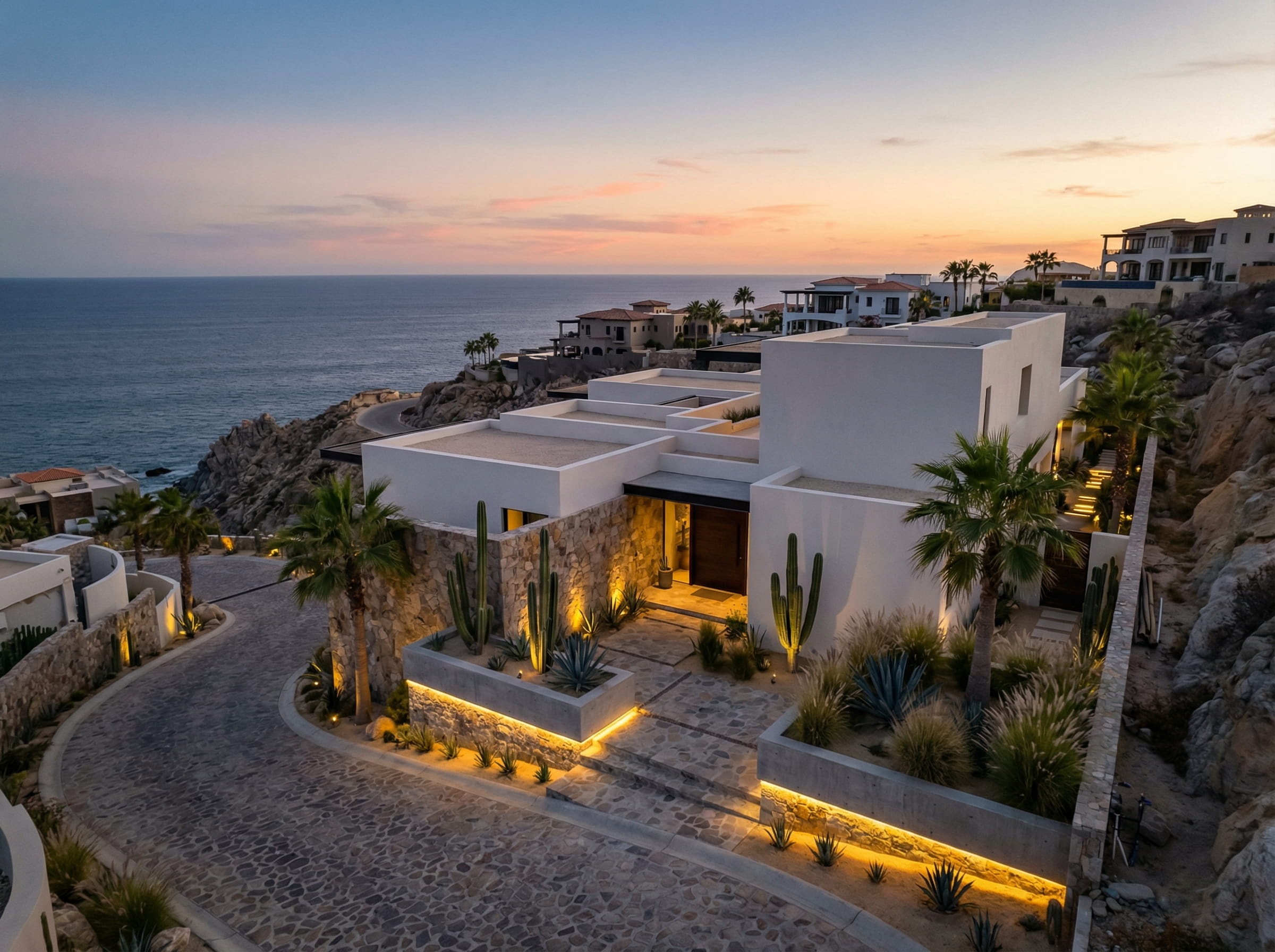
Most buyers arrive in Los Cabos expecting their budget to feel modest. They’ve spent time in Miami, the Hamptons, or Malibu, where a million dollars buys a decent two-bedroom with a view if you’re lucky. Then they step off the plane in Cabo San Lucas, drive past the Sea of Cortez at golden hour, and start touring properties. The shock runs in the opposite direction. A million dollars here goes further than almost anywhere else on the Pacific coast, and that surprises almost every first-time high-end buyer.
But the story is more nuanced than just “you get more for your money.” The market in Los Cabos is genuinely stratified. What you buy at the $1 million mark depends heavily on location, property type, legal structure, and timing. Understanding those variables before you start touring will save you from making a very expensive miscalculation.
The Los Cabos Market at a Glance
Los Cabos has spent the last decade transforming from a spring break destination into one of Latin America’s most serious luxury real estate markets. According to the Baja California Sur state government and various regional real estate associations, the corridor between Cabo San Lucas and San Jose del Cabo has seen consistent double-digit appreciation in the upper tier of the market for several years running.
That growth has been driven by a few converging forces. The expansion of international direct flights from major US and Canadian cities removed the friction of getting there. The rise of short-term rental platforms turned vacation properties into income-generating assets. And a post-pandemic shift in how buyers think about primary residence versus second home blurred those categories entirely. Many people who once planned to “retire here someday” quietly moved that timeline forward.
The result is a market that feels sophisticated, not speculative. Buyers at the $1 million level are not buying into a frontier market. They’re buying into an established ecosystem with recognised developers, established legal frameworks, and a professional class of agents who understand cross-border transactions.
What $1 Million Looks Like in Practice
The honest answer is: it depends on what you prioritise. Let’s break it down by property type.
Oceanfront Condos in the $900K to $1.2M Range
This is where most buyers start their search, and the surprise is usually pleasant. In gated communities along the Tourist Corridor, particularly around Pedregal, Quivira, or the Diamante development, $1 million commonly buys a two or three-bedroom condo with:
- Unobstructed Pacific or Sea of Cortez views
- Direct beach access or a community beachfront
- Resort-style amenities including pool, concierge, and security
- Finished interiors from reputable developers, often fully furnished
- Proximity to championship golf courses, some of the best in the world according to Golf Digest rankings
What it typically does not include at this price point is a private pool. For that, you’re generally moving toward the $1.3M to $1.5M range or shifting to a villa format.
Hillside Villas and Standalone Homes
If views matter more to you than direct beach access, a freestanding home becomes a genuinely realistic option around the $1 million mark. Neighbourhoods like El Tezal and Fundadores regularly list detached three and four-bedroom homes with private pools, casita-style guest quarters, and panoramic views of the bay and the famous Land’s End rock formation.
These properties suit buyers who want privacy and a more residential feel over the resort-style community experience. Many also carry strong rental income potential, since vacation travellers are often willing to pay premium nightly rates for a private pool villa.
Pre-Construction at a Premium Location
A third option that often catches buyers off guard is pre-construction in a marquee development. Several established developers in Los Cabos offer units at the $900K to $1.1M range during early sales phases in projects that will ultimately list at considerably higher prices upon completion.
The upside is obvious. You’re locking in today’s price in a market that has historically appreciated. The risk is equally obvious: construction timelines in Mexico can shift, and developer quality varies dramatically. This is where due diligence on the developer’s track record becomes non-negotiable.
The Legal Reality Every Buyer Needs to Understand
One element that surprises buyers at every price point is the fideicomiso system. Foreign nationals cannot directly own land within 50 kilometres of Mexico’s coastline. Instead, they hold the property through a bank trust called a fideicomiso, where a Mexican bank serves as the legal trustee while the buyer retains all beneficial rights.
This structure is not a loophole or a workaround. It is the standard, legally recognised method for foreign ownership and has been for decades. The rights it provides are comprehensive: you can rent the property, renovate it, sell it, and pass it on to your heirs. The annual trust fee typically runs between $500 and $700 USD, which amounts to an unremarkable carrying cost at the luxury level.
What does matter is choosing a reputable notario (a government-authorised notary public who oversees all real estate transactions in Mexico) and ensuring your purchase contract is reviewed by an independent attorney before signing. Cutting corners on this step has caused problems for buyers who assumed the process mirrored what they knew from home.
Working with a platform like MexHome gives buyers structured access to both legal guidance and vetted local agents who have done hundreds of these transactions. That continuity of knowledge matters more than most first-time buyers realise until they’re halfway through a deal.
Location Within Los Cabos: Not All Addresses Are Equal
Los Cabos is not one neighbourhood. It is a 33-kilometre corridor with distinct micro-markets, each with its own price dynamics, buyer profile, and lifestyle character.
Cabo San Lucas (the western end) is the most commercially active area, with the marina, nightlife, and a dense concentration of short-term rental demand. Buyers targeting maximum rental yield often gravitate here. For a detailed look at what’s available in this specific market, browsing Los Cabos listings by area gives a clearer sense of how price per square metre shifts just a few blocks from the waterfront.
The Tourist Corridor runs between the two towns and is where most of the major resort developments sit. Palmilla, Quivira, and Diamante are all corridor projects. This is the heart of the luxury market.
San Jose del Cabo offers a more colonial town atmosphere, with an arts district, local restaurants, and a slightly quieter pace. Buyers looking for a cultural anchor alongside their beach access often prefer this end. Prices here can run slightly lower per square metre for comparable finished quality, though that gap has narrowed in recent years.
Understanding which area matches your actual use case, whether that’s maximising rental weeks, creating a retirement base, or having a lock-and-leave second home, should drive your location decision before your property type decision.
What Sets Los Cabos Apart from Other Luxury Markets
Buyers who have also considered Costa Rica, the Dominican Republic, or Puerto Rico often cite a few consistent advantages when they land on Los Cabos.
First, infrastructure. The Los Cabos International Airport handles a volume of direct North American routes that few comparable markets can match. Same-day travel from major US cities is a genuine practical reality, not a marketing claim.
Second, the rental market is exceptionally well-developed. Platforms like Airbnb and VRBO, combined with a booming concierge travel industry, mean that a well-positioned property can generate 15 to 25 nightly bookings per month during high season from November through April.
Third, the regulatory environment for foreign buyers, while requiring guidance, is broadly predictable. The rules do not change arbitrarily. The fideicomiso structure, the notario process, and the closing costs (typically 4 to 7 percent of the purchase price) are consistent and well-documented. That predictability reduces risk in a way that buyers who have worked in less-regulated Latin American markets genuinely appreciate.
Key Takeaways
- At $1 million, buyers can realistically access oceanfront condos, hillside pool villas, or early-phase pre-construction in premium developments. The right choice depends on lifestyle priorities, not just budget.
- The fideicomiso trust system is the standard legal mechanism for foreign ownership in coastal Mexico. It is robust and well-established, but professional guidance through the process is essential.
- Location within Los Cabos matters as much as property type. Cabo San Lucas, the Tourist Corridor, and San Jose del Cabo each attract different buyer profiles and carry different rental dynamics.
- Pre-construction can offer meaningful price advantages but requires careful developer vetting. Never commit without reviewing the developer’s completed project history.
- Closing costs in Mexico typically run 4 to 7 percent of the purchase price and should be factored into total budget planning from the start.
Frequently Asked Questions
Can a US or Canadian citizen legally own a beachfront property in Los Cabos? Yes, through a fideicomiso (bank trust). The Mexican constitution restricts direct foreign ownership within 50 kilometres of the coastline, but the fideicomiso grants full beneficial rights including the ability to rent, renovate, sell, and inherit the property. It is a well-established legal structure used by thousands of foreign buyers every year.
Is $1 million considered entry-level or mid-range for luxury homes in Los Cabos? It sits at the entry to mid-range of the luxury segment. Truly premium properties, such as large beachfront estates, private compound-style villas, or penthouse units in flagship developments, generally start in the $2 million to $5 million range. At $1 million, buyers access a solid tier of quality with genuine resort amenities and significant lifestyle value.
What are the ongoing costs of owning a property in Los Cabos? Beyond the fideicomiso annual fee of roughly $500 to $700 USD, owners should budget for HOA or community fees (which vary widely by development), property taxes (predial, which are low by North American standards), property management if renting, and insurance. Total annual carrying costs on a $1 million property typically run between $8,000 and $15,000 USD depending on the property and management setup.
How strong is the short-term rental market in Los Cabos? Very strong, particularly from November through April. Los Cabos consistently ranks among the top-performing vacation rental markets in Latin America, with occupancy rates at well-priced properties regularly exceeding 60 to 70 percent during high season. The established tourist infrastructure and direct US flight network sustain that demand.
What should buyers watch out for in the pre-construction segment? The key risks are developer insolvency, construction delays, and discrepancies between the marketed specifications and the delivered product. Buyers should review the developer’s track record on completed projects, confirm that the land title is clean before paying any deposit, and have all contracts reviewed by an independent attorney before signing anything.
Final Thoughts
Los Cabos rewards buyers who arrive with realistic expectations and a clear sense of what they actually want from a property. The market is not a secret any more, but it still offers genuine value at the $1 million level, especially for buyers coming from overheated North American coastal markets. The legal framework is navigable, the rental income potential is real, and the lifestyle quality is difficult to argue with.
The surprise is not that you get a lot for your money. The surprise is how quickly the market starts to make sense once you stop comparing it to what you know from home and start learning it on its own terms.
